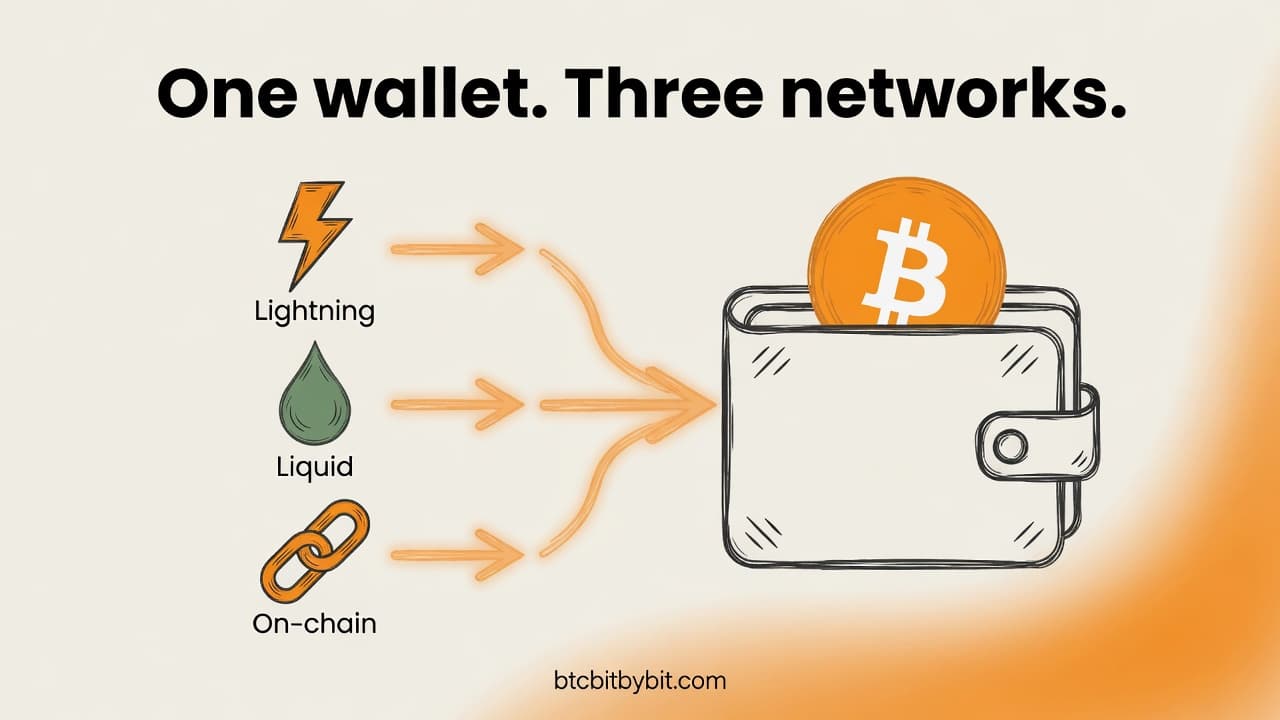
Lightning, Liquid, and On-Chain: One Wallet, Three Networks
When people talk about Bitcoin, they usually mean one thing: the Bitcoin network. The original blockchain, where transactions are recorded in blocks roughly every ten minutes, secured by proof of work.
But Bitcoin has evolved. Today, there are three distinct networks that move Bitcoin — each with different strengths. Understanding them isn't just technical trivia. It changes how you use Bitcoin day to day and what you should expect from a wallet.
On-Chain: The Foundation
On-chain is the original Bitcoin network. Every transaction is broadcast to the entire network, verified by miners, and permanently recorded on the blockchain.
Strengths: absolute finality, maximum security, global consensus. When a transaction is confirmed on-chain, it is settled. No intermediary can reverse it. No company can dispute it. It is as permanent as anything digital can be.
Trade-offs: on-chain transactions take time (typically 10-60 minutes for confirmation) and cost fees that vary with network demand. During busy periods, fees can be high. For small, everyday transactions, on-chain can be impractical.
On-chain is best for larger amounts, long-term storage, and transactions where finality matters more than speed.
Lightning: Instant Payments
The Lightning Network is a layer built on top of Bitcoin's blockchain. It enables instant payments with minimal fees by creating payment channels between users. Transactions happen off-chain but are ultimately secured by the Bitcoin blockchain.
The numbers tell the story. In late 2025, Lightning processed over $1 billion in monthly volume — a 300% increase year over year. It's not a prototype. It's production infrastructure that moves serious value.
Strengths: near-instant settlement (seconds, not minutes), fees measured in fractions of a cent, and the ability to handle micro-payments that would be impractical on-chain. When you buy a coffee with Bitcoin or earn sats from a quiz, Lightning is usually what makes it feel seamless.
Trade-offs: Lightning requires liquidity in payment channels. Very large payments may need to be routed through multiple channels. And while Lightning is secured by Bitcoin's blockchain, the transactions themselves don't have the same on-chain finality until channels are closed.
Lightning is best for everyday payments, small amounts, and anything where speed matters.
Liquid: The Middle Ground
Liquid is a federated sidechain — a separate network that's pegged to Bitcoin. You move Bitcoin onto Liquid, use it there, and can move it back to the main chain whenever you want.
Strengths: faster confirmation times than on-chain (about 2 minutes), lower fees than on-chain during busy periods, and confidential transactions — the amounts are hidden from public view by default. Liquid also supports larger payments more naturally than Lightning.
Trade-offs: Liquid is federated, meaning it's secured by a group of known entities (called functionaries) rather than the fully decentralised mining network. This makes it faster but introduces a different trust model. You're trusting the federation to operate honestly, rather than trusting mathematics alone.
Liquid is best for medium-to-large transfers where speed and privacy matter, and where the full security of on-chain isn't required.
Why One Wallet Matters
Most Bitcoin users who interact with all three networks end up managing multiple wallets or manually choosing which network to use for each transaction. This creates friction, confusion, and mistakes — especially for people who are still learning.
BTCBitByBit's wallet handles Lightning, Liquid, and on-chain from a single balance. You see one number. When you send or receive, the wallet selects the appropriate network automatically based on the transaction type, amount, and conditions.
You don't need to know the difference between the three networks to use the wallet. But if you want to learn — and you should, because understanding how your money moves is part of financial literacy — the Learn & Earn lessons cover it.
The wallet is built on Breez SDK, an open-source, self-custodial Lightning integration. The keys are generated and stored on your device. No server holds them. No company has access. The code is open and auditable.
What This Means for You
If you're new to Bitcoin, the three-network complexity is exactly the kind of thing that makes people give up. "Which wallet do I use?" "How do I pay with Lightning?" "What's Liquid?" These are valid questions that shouldn't require a computer science degree to answer.
The answer, increasingly, is that the wallet should handle it. You should be able to send and receive Bitcoin without thinking about which network carries it — the same way you send an email without thinking about which server routes it.
That's the design principle behind BTCBitByBit's wallet. One balance. Three networks. Self-custody. Keys on your device. The wallet does the routing. You get the result.
And while you're at it, you can earn sats by learning about exactly how it all works. Pass the quiz. Keep the sats. Understand what you own.