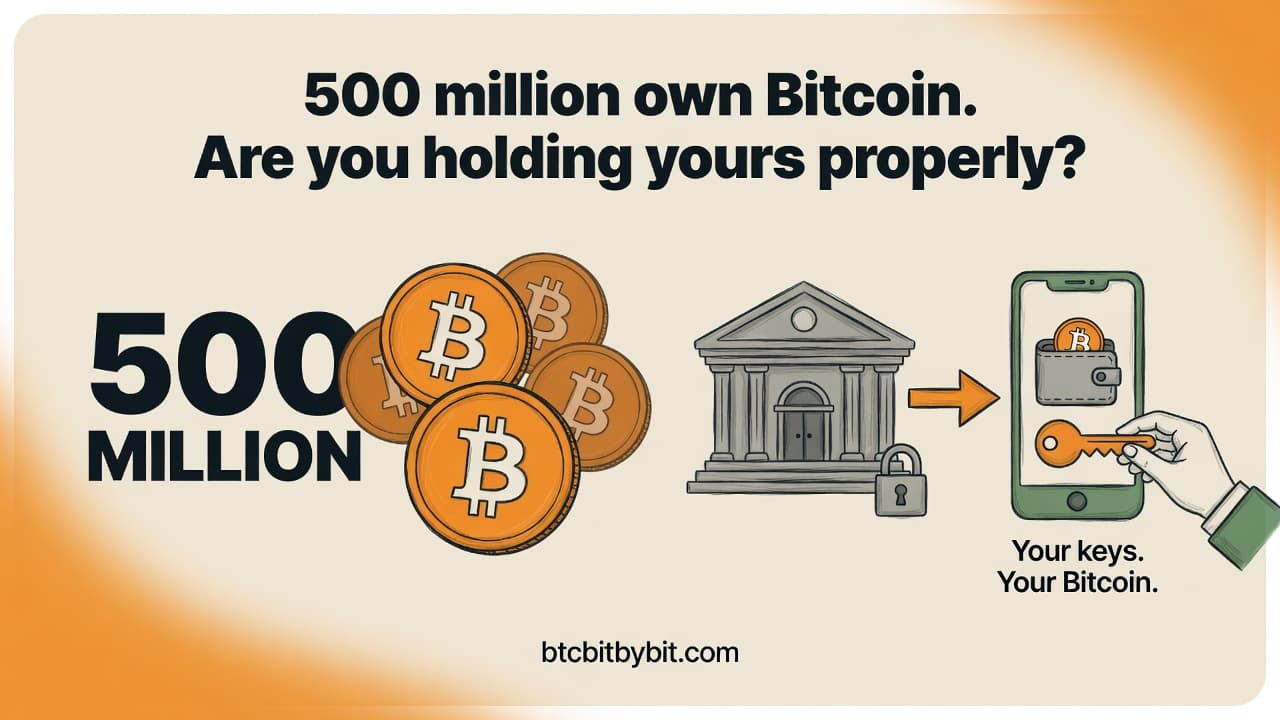
500 Million People Own Bitcoin. Are You Holding Yours Properly?
The numbers have shifted. Five hundred million people now own Bitcoin globally. In the United States alone, 30% of adults hold cryptocurrency. The Lightning Network — Bitcoin's instant payment layer — processed over $1 billion in monthly volume in late 2025, growing 300% year over year.
Bitcoin is no longer a niche experiment. It's financial infrastructure that hundreds of millions of people use. But as ownership grows, a critical question gets louder: how are all these people holding their Bitcoin?
The Difference Between Owning and Holding
There's a distinction most newcomers don't think about until it's too late. Owning Bitcoin on an exchange and holding Bitcoin in a self-custody wallet are fundamentally different things.
When you buy Bitcoin on an exchange and leave it there, the exchange holds your keys. They control access to your Bitcoin. You have an account balance — a number on a screen — but the actual Bitcoin sits in wallets the exchange controls. If the exchange goes down, gets hacked, freezes withdrawals, or makes a business decision you disagree with, your access disappears.
This isn't theoretical. It has happened repeatedly. High-profile exchange collapses have cost users billions. The phrase "not your keys, not your coins" exists for a reason.
Self-custody means your keys are generated and stored on your device. No intermediary holds them. No company needs to stay solvent for you to access your Bitcoin. You hold it the way you hold cash in your hand — except it's secured by cryptography instead of a physical vault.
Why Self-Custody Matters More at Scale
When 500 million people own Bitcoin, the stakes of custody go up, not down. More users mean more value concentrated on fewer platforms. The incentive for bad actors — whether hackers, rogue insiders, or overreaching regulators — increases with every million new users who leave their Bitcoin on a centralised platform.
Self-custody distributes that risk. When each person holds their own keys, there is no single point of failure. No honeypot. No company that can freeze your balance with an email.
This is what Bitcoin was designed for. The entire architecture — the decentralised network, the cryptographic key pairs, the peer-to-peer transactions — assumes that users hold their own keys. Centralised custody was a convenience layer bolted on afterwards. Self-custody is the native state.
Three Networks, One Wallet
One of the reasons people default to exchanges is that managing a Bitcoin wallet used to be complicated. Different networks meant different wallets. Lightning for fast payments, on-chain for larger transfers, and Liquid for privacy and speed — each with its own setup.
BTCBitByBit's wallet handles all three from one balance. The wallet selects the appropriate network automatically. You don't need to understand the technical differences to use it — the wallet does the thinking. But if you want to understand, the Learn & Earn lessons will teach you.
Lightning for instant, low-fee payments. Liquid for fast, confidential transfers. On-chain for settlement and larger amounts. One balance. One wallet. Keys on your device.
Built on Breez SDK — an open-source, self-custodial Lightning integration — the wallet is transparent about how it works. There's no black box. The technology is auditable. The code is open.
Beyond the Wallet
Self-custody is the foundation, but BTCBitByBit is more than a wallet. It's an education platform that happens to have a wallet at its core — because true understanding of Bitcoin includes understanding ownership.
Bite-sized lessons cover Bitcoin, money, savings, and self-custody itself. Pass the quiz, earn sats. The sats go to the same self-custody wallet. You're not earning points or promises — you're earning Bitcoin to a wallet where you hold the keys.
Every subscriber gets 50% of their subscription value back in Bitcoin each month. Use a promo code and it doubles to 100%. The sats-back, the Learn & Earn rewards, and any Bitcoin you receive all flow to one wallet.
For families, kids get their own wallet. Parents choose the mode — self-custody or redeem-only. Kids log in with a name and PIN. The whole family learns, earns, and holds — together.
Holding It Properly
500 million people own Bitcoin. The question isn't whether to own it — that decision has been made by hundreds of millions already. The question is whether you're holding it in a way that honours what Bitcoin actually is: money you control, on a device you own, without permission from anyone.
Self-custody isn't a feature. It's the point.